Avoiding Skids: Motorhome Driving Techniques for Wet Autumn Roads
Published August 31, 2026
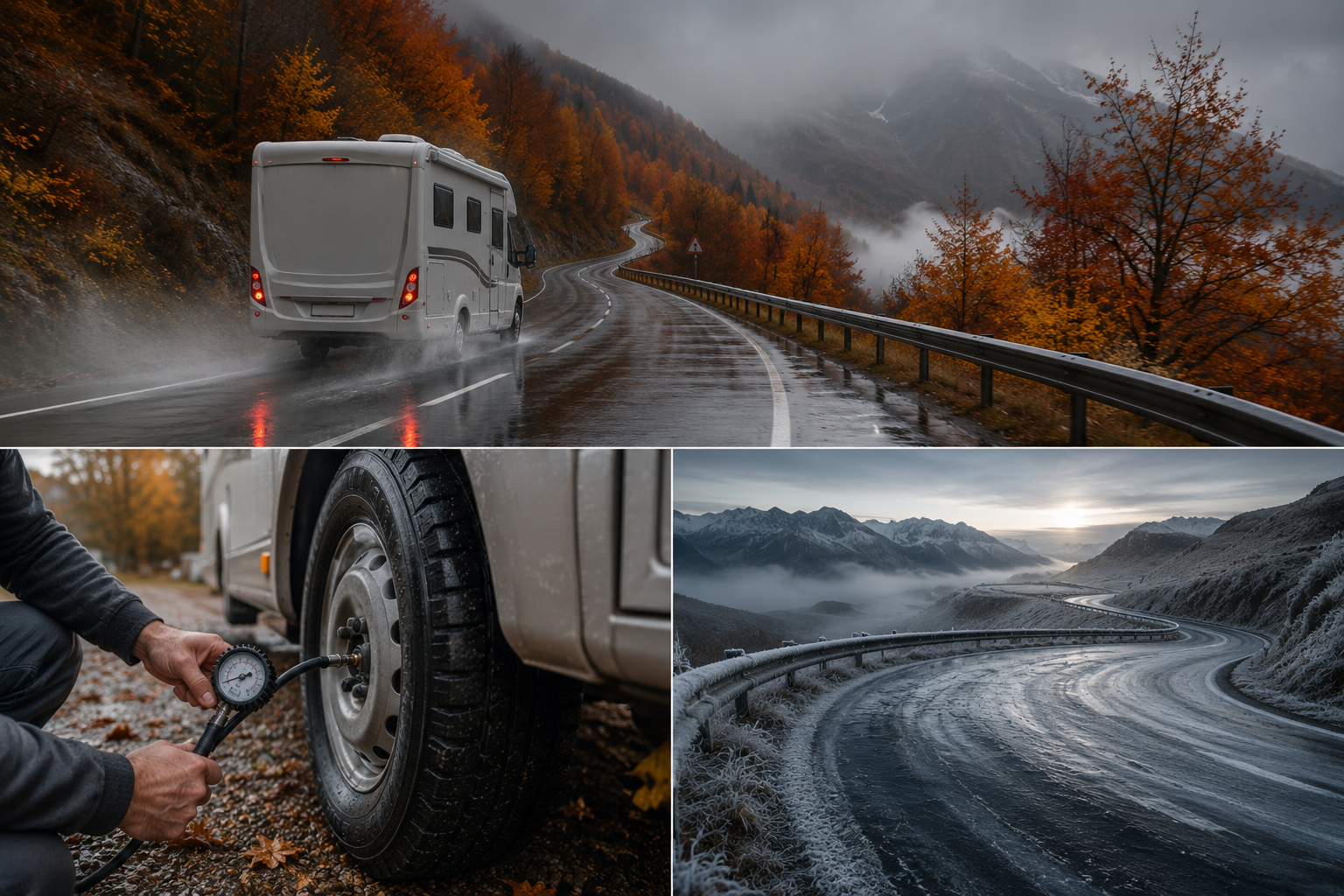
AI-generated image
October might be one of the most beautiful months for motorhome travel — blazing autumn foliage, low morning mist and quieter campsites — but it's also the month when the roads genuinely start turning tricky. Rain gets colder, the asphalt rarely dries fully between showers, and higher mountain passes can already flirt with freezing overnight. For a tall, wind-sensitive motorhome with a high center of gravity, that combination demands a different mindset than summer driving.
The first thing to reset is your expectation of braking distance. A fully loaded motorhome at 3.5–4.5 tonnes weighs far more than a car, and on wet asphalt the braking distance increases dramatically compared to dry conditions — plan for at least double, often more if the tyres are worn. Add to that the fact many motorhomes have weaker rear braking due to weight distribution toward the front axle, making the rear end more prone to locking up or sliding under hard braking. Practical tip: increase your following distance to at least 4–5 seconds instead of the usual 2–3, and test your brakes gently and early on descents to gauge grip before you actually need it. In passes like the Gotthard, Brenner or France's Col de la Croix-Haute, rain on one side of the summit can suddenly turn into freezing rain or black ice higher up — often visible only as a glossy, seemingly-wet sheen that's actually solid ice.
Tyre pressure is the next thing that's easy to overlook. Many drivers set pressure once in spring and never adjust it, even though load and temperature change. Cooler autumn air naturally lowers tyre pressure — roughly 0.1 bar for every 10°C drop. Underinflated tyres drain water from the tread far less effectively, sharply increasing hydroplaning risk above roughly 80 km/h on wet roads. Check pressure cold, at least weekly through autumn, and stick to the manufacturer's figure for your current load — usually found on a sticker inside the driver's door or in the manual. Trailers and caravans should be checked separately, as they often run entirely different pressures than the tow vehicle. If tread depth drops below 4 mm, it's time for new tyres before winter — the legal minimum in many countries is 1.6 mm, but hydroplaning margins are already thin at 3 mm.
Speed is the one variable you can actually adjust in the moment, and it's the most underrated. Cut your speed by at least 20–30% compared to dry conditions the moment light rain starts, and more in mountainous sections with curves and elevation change. On descents, downshift instead of relying on the brakes alone — it takes load off the braking system and reduces the risk of brake fade, which is especially dangerous on long alpine descents with a heavy vehicle. Watch out for bridges and tunnel mouths too: bridges freeze before the surrounding road because cold acts from both above and below, and tunnel entrances can hide a slick, damp patch in shadow even when the rest of the road looks dry.
Early frost in mountain passes is the trap many drivers miss in October, because down in the valley it still feels like autumn. Check the forecast for specific pass altitudes, not just your starting town — services like Alpine Passes or national road authorities (France's Bison Futé, Switzerland's TCS) offer updated info on higher-elevation conditions. Consider carrying snow chains even in October if you're crossing passes above 1500 metres; several alpine countries legally require them from November 1st or whenever winter conditions are signposted, regardless of calendar date.
Finally: plan your route so you're not driving in darkness and rain simultaneously, which dramatically worsens visibility on wet asphalt. Many drivers start early and stop well before dusk instead. This is where RoadTide comes in handy — scouting suitable campsites or stopovers along your route in advance means you're not searching for a spot in the dark and rain, which often ends up being the most dangerous part of the whole day's drive.